

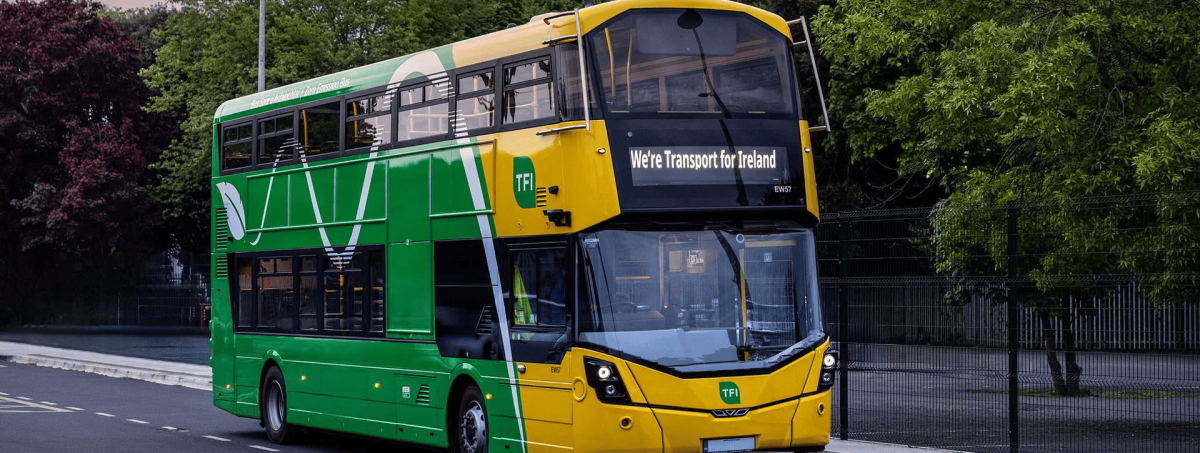
Ireland’s National Transport Authority (NTA) has launched a major public procurement programme that could support the purchase of up to 1,800 double-deck buses, strengthening the framework for long-term fleet renewal and the transition towards zero-emission public transport.
The procurement comprises four framework agreements covering up to 1,500 two-axle battery-electric double-deck buses, 200 three-axle battery-electric double-deck buses and 100 regional-specification double-deck vehicles. The overall framework has a maximum value of €1.5 billion, according to the NTA procurement notice published through eTenders.
The structure is significant from a procurement perspective because it gives the NTA flexibility to manage future purchasing requirements while maintaining competition between suppliers. Two frameworks will cover two-axle electric buses, with one designed for a single supplier and another involving multiple suppliers. Under the multi-supplier arrangement, future orders can be subject to further competition between manufacturers admitted to the framework.
This approach allows procurement decisions to adapt as fleet requirements, technology and market conditions develop. The frameworks will initially run for 30 months and can be extended by up to a further 66 months, potentially providing an eight-year procurement horizon.
The programme also supports Ireland’s wider public transport and climate objectives. The NTA’s fleet transition plans have increasingly focused on zero-emission vehicles for urban public transport, with electric buses already forming a growing proportion of the State-supported fleet.
According to Magyarbusz’s report, 384 battery-electric buses were operating on Ireland’s urban Public Service Obligation network by June 2026, representing almost one-fifth of the fleet. A further 98 electric buses purchased by the NTA were awaiting entry into service.
The latest framework therefore builds on an established procurement programme rather than representing a standalone investment. It gives manufacturers greater visibility of potential future demand while providing the public authority with greater choice over suppliers, volumes and vehicle specifications.
The scale of the framework also demonstrates how strategic public procurement can support wider infrastructure priorities. By combining long-term fleet planning with competitive purchasing arrangements, the NTA can pursue value for money while creating a procurement platform capable of responding to the evolving public transport market.
For the sector, the lesson is clear: major public procurement programmes can deliver more than immediate purchasing needs. By combining scale, competition and flexibility, the NTA’s latest framework provides a strategic mechanism for supporting fleet renewal, supplier participation and Ireland’s longer-term shift towards cleaner public transport.
Source: Magyarbusz / National Transport Authority / eTenders / Department of Transport












.png)